Who each order type is written for, in Hipobuy's own words
Hipobuy attaches an 'Applicable to' line to both order types; read side by side, the two lines describe several kinds of buyer, and only one of them is written under the agent order.
The one line under the agent order
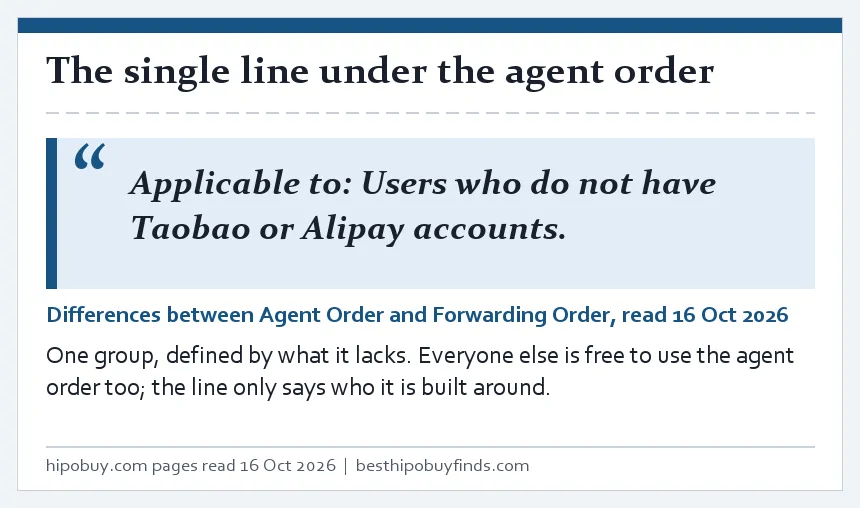
The agent order's line is short: it is for users who do not have Taobao or Alipay accounts. That describes most overseas buyers. A Taobao account can be opened from abroad, but paying sellers in China, reading the seller chat and handling a dispute in Chinese is a different matter, and the agent order exists so that you do not have to.
Hipobuy's homepage puts the agent's reach widely: it says it will help you buy from all channels in China, online and offline, and that you only need to paste the product link. In practice the agent order is the default, and the forwarding order is the exception you choose for a reason.
Nothing stops an account holder from using the agent order. Plenty do, because the agent order is where the return guarantee and the buyer agent live.
The groups under the forwarding order
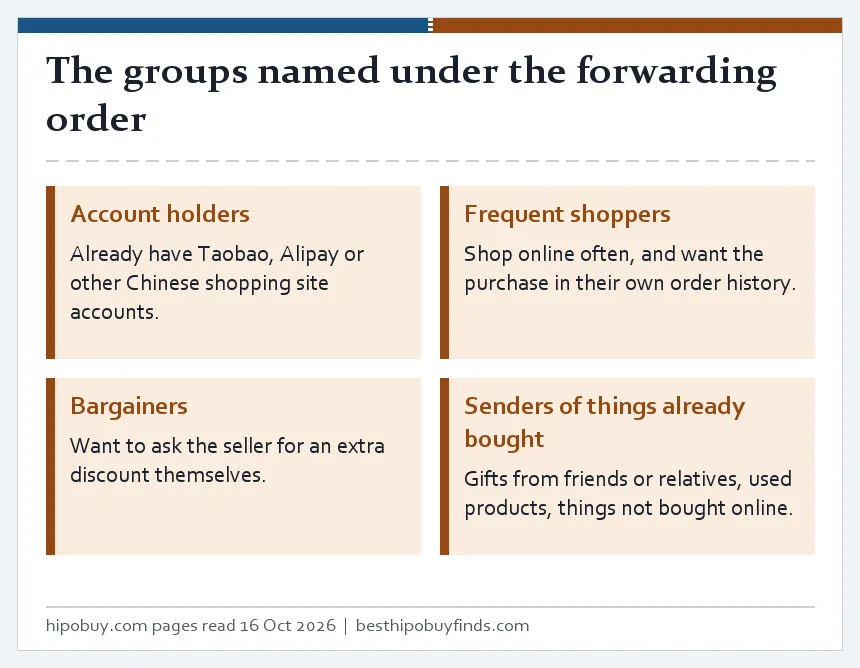
The forwarding order's line is longer, and it splits into two kinds of buyer. The first kind can buy in China without help: people who already hold Taobao, Alipay or other Chinese shopping accounts, shop online often, or want to ask sellers for extra discounts.
The second kind has nothing left to buy: gifts from friends or relatives, used products, and products that were not purchased online. For them, an agent order would have no purchase to make; only the shipping is needed.
Both kinds accept the same trade, which Hipobuy writes into the forwarding terms: the purchase is theirs, so the after-sales is theirs too.
Domestic senders and overseas buyers
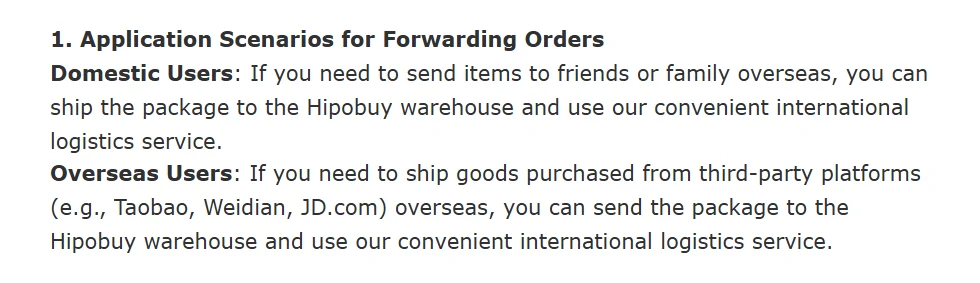
Hipobuy's forwarding tutorial frames the same groups by where you are. Domestic users, people in China, use forwarding when a parcel has to reach relatives or friends abroad. Overseas users use it to ship goods they bought on third-party platforms, and the tutorial names Taobao, Weidian and JD.com.
The first case is the cleanest fit: a relative in China buys or packs something, posts it to the warehouse, and the overseas recipient pays only for the parcel. The second case is where the trade-offs bite, because an overseas buyer who used their own account is now the only person who can raise a problem with the seller.
If you are the overseas buyer, ask the seller for the courier number in writing and keep the order screenshot. Hipobuy will not have either unless you give it to them.
Bargaining with a seller yourself
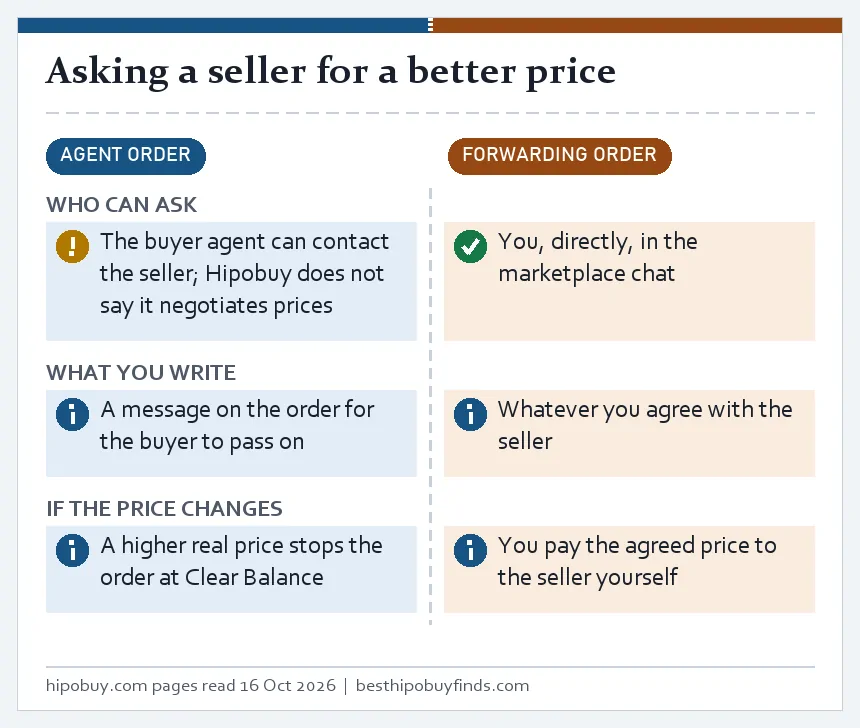
One reason Hipobuy gives for forwarding is wanting to ask sellers for additional discounts. That is a real difference: in your own account you can chat with the seller, agree a lower price, and pay it.
In an agent order you can leave a message for the buyer, and the buyer agent can contact the seller, but Hipobuy's pages do not say whether a buyer will negotiate a price for you. If the price on the order is wrong in the other direction, higher than you paid, the order stops at Clear Balance until you pay the difference.
So the bargaining argument is strongest for buyers who already chat with Chinese sellers. For anyone else it is a small saving bought with the whole after-sales chain.
Second-hand goods and shop purchases
Used products appear in the forwarding line, but they are not barred from the agent side. Hipobuy's beginner guide sends Goofish (Xianyu) listings through Fill and Buy, which is an agent order. What changes is the return: the five-day guarantee lists second-hand products as ineligible, so a used item bought by Hipobuy is no easier to send back than one you forward.
Shop purchases are the reverse. The forwarding line names products that are not purchased online, while Hipobuy's homepage says the agent can help buy offline goods too. On the agent side the route for that is the Customized Order on the Custom Order page, where you describe or photograph the item and the buyer tries to find it; the form says its service fee is not refunded if you then decline what the buyer finds.
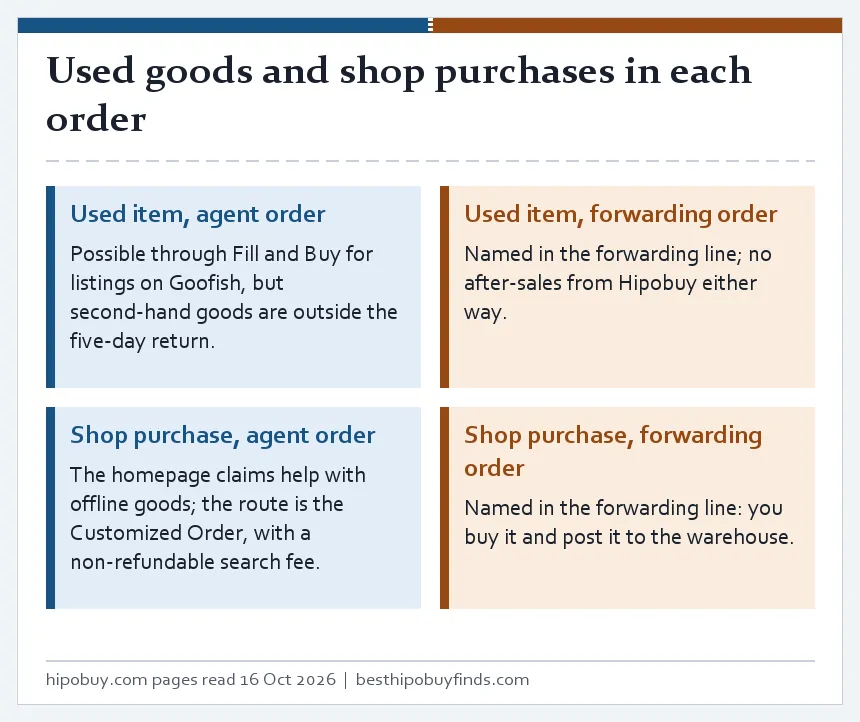
For a used camera or a jacket from a market stall, then, the order type changes who handles the purchase more than what protection you end up with.
When another agent may suit you better
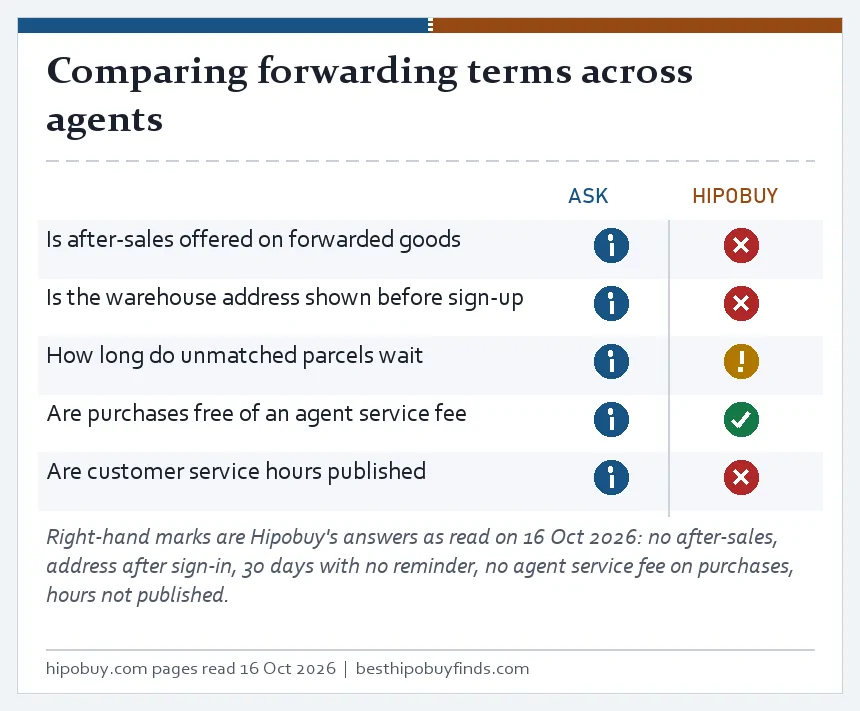
Hipobuy's forwarding terms are clear, and they are not generous: no after-sales on forwarded goods, no compensation for missing pieces it did not cause, the address only after sign-in, and 30 days with no reminder for a parcel it cannot match. If your plan depends on any of those, compare other shopping agents before you send.
When choosing an agent for forwarding, judge it by what it writes down: whether it offers any after-sales on forwarded goods, how long it keeps unmatched parcels and whether it warns you, whether customer service hours are published, and whether its fees for purchases are stated. Hipobuy's own answers to those are in the figure.
We do not rank agents. Many other agents you will also see run both kinds of order; the right one is the one whose written terms match the parcel you are about to send.